


1. Raw Material Optimization: Lowering Adhesiveness at the Source
The most proactive solution is to control the properties and tackiness of your raw material before it ever hits the granulation loop.
Strict Moisture Management
Moisture is the critical factor driving material tackiness, as excess or insufficient moisture will disrupt the process. We recommend utilizing real-time sensors to monitor and stabilize moisture levels. Optimum moisture content varies heavily depending on the feedstock:
| Fertilizer Material Type | Recommended Moisture Range |
| Compound Fertilizer | 8% – 15% |
| High-Sugar Materials (e.g. Sugar Residue) | 20% – 40% |
| General Organic Fertilizer | 30% – 50% |
| Poultry & Livestock Manure | 30% – 45% |
| Bio-Organic Fertilizer | 30% – 45% |
Pre-Treatment & Formulation Adjustments
- Milling Fineness: Ensure raw materials are thoroughly crushed so that at least 80% passes through a 40-mesh screen, to prevent large lumps of material from becoming adhesion nuclei.
- Conditioning High-Stick Inputs: Blend highly sticky raw materials with loose, structural biomass. For example, highly adhesive fermented chicken manure should be pre-mixed in a calculated ratio with loose straw powder.
- Controlled Binder Usage: When adding binders like bentonite or starch to low-adhesion materials, the dosage must be strictly controlled. Excess binding agents will accelerate the pan build-up.
EMCC Solution: EMCC provides professional controllable feeding systems for precise material blending, pre-crushing systems for optimal feedstock sizing, and intensive pre-granulation mixers to guarantee a completely homogeneous feed.
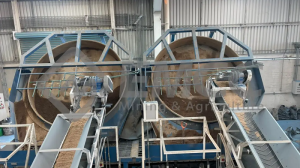
Proper pan motion parameters enable the material to maintain a “tumbling” state within the pan, thereby reducing static contact with the pan walls. The pan rotation speed and inclination are the core anti-sticking operational parameters and must be adjusted in tandem to maintain physical equilibrium. EMCC Engineering Support: EMCC offers professional technical consulting and can calculate the mathematically ideal inclination and rotation speed specifically tailored to your raw material and product. EMCC Advantages: EMCC custom-tailors material conveyor belts with optimized width, length, and integrated variable frequency drives (VFD) to ensure a perfectly seamless, uniform feed.2. Machine Adjustment: Getting Materials “Moving”
Rotation Speed and Inclination Interdependence
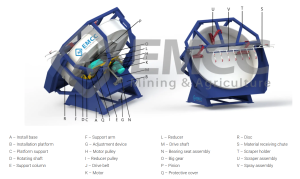
Parameter Operational Principle Adjustment Logic Standard Range Pan Inclination Larger angles reduce material retention time, preventing static build-up. Increase the angle for sticky materials; decrease it for dry/loose blends. normally 35°-55° Pan Rotation Speed Higher speeds increase centrifugal force, tossing the material and minimizing wall contact time. Must match the tilt angle. Increase the rotation speed for high-stick materials. Varies by pan diameter. Requires calculation by technicians. Precision Feeding and Atomized Spraying
3. Upgrades and Modifications: Equipping Machinery with an “Anti-Adhesion Shield”
For materials with high tackiness, physical and mechanical modifications can be added to break the adhesion layer automatically.
- Upgrading Anti-Adhesion Coatings: Applying a low-surface-energy coating to the inner walls of the granulation disc is a highly effective strategy. Among these options, Teflon (PTFE) coatings remain the most widely used and effective choice in industrial applications. Additionally, polymer composite materials, ceramic coatings, or super-hydrophobic coatings may also be considered.
- Installing Scraper Assemblies: This constitutes the most effective anti-adhesion accessory, capable of “actively” removing newly formed layers of adhered material. Key Configuration: Ensure the equipment is fitted with both disc-bottom scrapers and disc-side scrapers to prevent material accumulation on the base and sidewalls of the disc. Technical Considerations: It is recommended to select wear-resistant materials for the scrapers, maintain a clearance gap of 1–2 mm, and conduct regular inspections to monitor for wear.
- Adding Auxiliary Devices: Installing high-frequency vibrators on the underside of the granulation disc generates high-frequency, low-amplitude vibrations that make it difficult for material to adhere to the surface. Additionally, compressed air nozzles can be installed at specific locations to utilize airflow in assisting with blowing off materials.
EMCC Customization: All the above armor upgrades and wear-resistant coatings are fully supported and customizable on EMCC granulation discs.
4. Routine Maintenance and Cleaning: Maintaining Optimal Condition
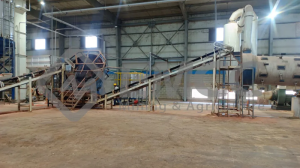
- Regular Cleaning: Establish a routine cleaning schedule. This can be achieved by running the equipment at a low speed while using dry auxiliary materials to frictionally remove adhering residues, or by manually cleaning the interior with a soft scraper after shutting down the machine.
- Equipment Maintenance: For highly tacky materials (such as sugar residue), frequent inspections are essential. Anti-stick coatings must be repaired promptly if they show signs of wear, and scraper blades should be replaced immediately once they become dull.
- Shutdown Procedures: Prior to a planned shutdown, stop feeding high-moisture materials into the machine. Allow the equipment to continue running for a period of time to substantially discharge any residual material remaining in the pan; this prevents the material from drying out and hardening after cooling, which would significantly increase the difficulty of subsequent cleaning.
EMCC equipment is supplied with a comprehensive maintenance manual, enabling operators to perform routine maintenance directly by following the provided instructions.
Summary and Recommended Solutions
The most effective approach to resolving the issue of material adhesion (sticking) in disc granulators is a multi-pronged strategy. You should begin by optimizing the material’s moisture content and adjusting the pan’s inclination angle and rotational speed, while ensuring that water is applied uniformly using atomizing spray nozzles. If the material remains highly tacky, consider implementing anti-stick coatings or installing scraper blades.
Anti-Stick Strategies Tailored to Different Material Types:
- Highly Tacky Materials (e.g., Sugar Residue, Certain Fermented Manures): Reliance on a combination of anti-stick coatings and high-efficiency scrapers is mandatory, alongside strict control over moisture levels and temperature.
- Moderately Tacky Materials (e.g., Compound Fertilizers): The primary focus should be on precisely adjusting the pan angle and rotational speed, while ensuring uniform liquid spraying.
- Fibrous, Loose Materials: These materials typically possess low inherent viscosity; adhesion issues usually arise from excessive moisture content or inadequate mixing with more tacky materials. Therefore, priority should be given to inspecting and optimizing moisture control and material pre-treatment processes.