


The EMCC disc granulator (pan pelletizer) operates on a principle that mimics a natural phenomenon: snowballing. Through wet agglomeration, it transforms fine powders into uniform spherical granules, typically ranging from 1 to 6 mm in diameter.
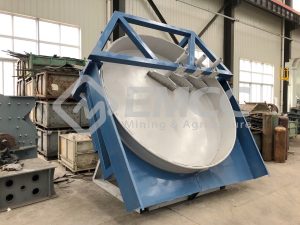
The entire process can be broken down into three interconnected stages. Let’s explore each one in detail.
Stage 1: Raw Material Nucleation — The Starting Point
This is where every granule begins its life. A controlled stream of dry powder is continuously fed onto an inclined, rotating disc. At the same time, a precisely metered liquid binder—usually water or a specialized solution—is introduced through a spray system.
How Nucleation Works
Under the influence of capillary action, the wetted fine particles stick together, forming dense, tiny cores. These initial agglomerates are commonly called “mother balls” or “seed nuclei.”
Industrial Detail: Why Atomization Matters
The way the liquid meets the powder is critical to success. The binder must be atomized into micrometer-scale droplets and distributed evenly. If the liquid is injected as a coarse stream or column, it creates localized over-wetting, resulting in mud clumps and material sticking to the disc wall. Uniform atomization, on the other hand, coats each particle with an ultra-thin liquid film. This prevents adhesion from the very start and ensures that the seed nuclei are consistent in size. The quality of this step directly determines the uniformity and yield of the final granules. EMCC disc granulators are equipped with customizable atomizing spray systems tailored to your specific raw material.
Stage 2: Layered Growth — Building Strength and Uniformity
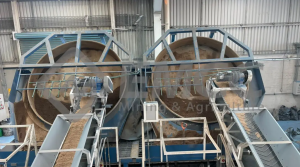
Once the mother balls have formed, they don’t stay still. They enter a continuous “forging” process driven by the disc’s unique motion.
The Driving Force Behind the Movement
The disc’s rotation generates centrifugal and friction forces that carry the particles upward. The inclination angle of the pan then uses gravity to cascade them back down. This constant rise-and-fall cycle is the engine behind all the collision, tumbling, and growth.
“Onion-Skin” Layering
As the mother balls repeatedly tumble, they collide with and pick up fresh dry powder. This material wraps around them layer by layer, much like the skins of an onion. But this is not a loose accumulation; the impact and friction generated during the tumbling action compact the moisture and fine particles between the layers, squeezing out air and continuously increasing the granule’s strength and density.
Controlling Granule Uniformity
By adjusting the rotation speed of the disc, operators can precisely control the ratio between rolling and cascading. Higher speeds carry material further up the pan before it falls, intensifying the impact compaction. The result? Denser, more spherical particles with excellent uniformity.
Stage 3: Automatic Classification — The Ingenuity of Physical Laws
This is the disc granulator’s most ingenious feature. It achieves size-based separation without any external screening equipment.
The Principle Behind Separation
The process relies on the Brazil Nut Effect: when a bed of particles of different sizes is shaken or rotated, smaller particles tend to percolate downward through the gaps between larger ones. This pushes the larger particles to the surface. Learn more about the Brazil Nut Effect here.
Precise Overflow Discharge
With a typical disc inclination of 45°–55°, friction drives the larger surface-level particles (1–6 mm) upward along with the disc’s rim. Once they reach the edge, they continuously overflow and are discharged as finished product. Meanwhile, the finer powder and still-growing smaller balls remain concentrated in the bottom region due to gravity, where they continue the granulation cycle. This built-in automatic classification mechanism guarantees a highly uniform discharge particle size.
Conclusion: A Perfect Dynamic Balance
The three stages—nucleation, layered growth, and automatic classification—work together in a precise dynamic balance. This is what enables the disc granulator to efficiently and consistently transform fine powder into uniform spherical granules. The process is ideal for applications that demand high particle roundness and production flexibility.
Looking for a tailored granulation solution? Contact EMCC technical support today for a customized system designed around your material.